Monday, August 31, 2009

Op-Ed Columnist - Missing Richard Nixon - NYTimes.com


August 31, 2009

Op-Ed Columnist

Missing Richard Nixon

By PAUL KRUGMAN

Many of the retrospectives on Ted Kennedy’s life mention his regret that he didn’t accept Richard Nixon’s offer of a bipartisan health care deal. The moral some commentators take from that regret is that today’s health care reformers should do what Mr. Kennedy balked at doing back then, and reach out to the other side.

But it’s a bad analogy, because today’s political scene is nothing like that of the early 1970s. In fact, surveying current politics, I find myself missing Richard Nixon.

No, I haven’t lost my mind. Nixon was surely the worst person other than Dick Cheney ever to control the executive branch.

But the Nixon era was a time in which leading figures in both parties were capable of speaking rationally about policy, and in which policy decisions weren’t as warped by corporate cash as they are now. America is a better country in many ways than it was 35 years ago, but our political system’s ability to deal with real problems has been degraded to such an extent that I sometimes wonder whether the country is still governable.

As many people have pointed out, Nixon’s proposal for health care reform looks a lot like Democratic proposals today. In fact, in some ways it was stronger. Right now, Republicans are balking at the idea of requiring that large employers offer health insurance to their workers; Nixon proposed requiring that all employers, not just large companies, offer insurance.

Nixon also embraced tighter regulation of insurers, calling on states to “approve specific plans, oversee rates, ensure adequate disclosure, require an annual audit and take other appropriate measures.” No illusions there about how the magic of the marketplace solves all problems.

So what happened to the days when a Republican president could sound so nonideological, and offer such a reasonable proposal?

Part of the answer is that the right-wing fringe, which has always been around — as an article by the historian Rick Perlstein puts it, “crazy is a pre-existing condition” — has now, in effect, taken over one of our two major parties. Moderate Republicans, the sort of people with whom one might have been able to negotiate a health care deal, have either been driven out of the party or intimidated into silence. Whom are Democrats supposed to reach out to, when Senator Chuck Grassley of Iowa, who was supposed to be the linchpin of any deal, helped feed the “death panel” lies?

But there’s another reason health care reform is much harder now than it would have been under Nixon: the vast expansion of corporate influence.

We tend to think of the way things are now, with a huge army of lobbyists permanently camped in the corridors of power, with corporations prepared to unleash misleading ads and organize fake grass-roots protests against any legislation that threatens their bottom line, as the way it always was. But our corporate-cash-dominated system is a relatively recent creation, dating mainly from the late 1970s.

And now that this system exists, reform of any kind has become extremely difficult. That’s especially true for health care, where growing spending has made the vested interests far more powerful than they were in Nixon’s day. The health insurance industry, in particular, saw its premiums go from 1.5 percent of G.D.P. in 1970 to 5.5 percent in 2007, so that a once minor player has become a political behemoth, one that is currently spending $1.4 million a day lobbying Congress.

That spending fuels debates that otherwise seem incomprehensible. Why are “centrist” Democrats like Senator Kent Conrad of North Dakota so opposed to letting a public plan, in which Americans can buy their insurance directly from the government, compete with private insurers? Never mind their often incoherent arguments; what it comes down to is the money.

Given the combination of G.O.P. extremism and corporate power, it’s now doubtful whether health reform, even if we get it — which is by no means certain — will be anywhere near as good as Nixon’s proposal, even though Democrats control the White House and have a large Congressional majority.

And what about other challenges? Every desperately needed reform I can think of, from controlling greenhouse gases to restoring fiscal balance, will have to run the same gantlet of lobbying and lies.

I’m not saying that reformers should give up. They do, however, have to realize what they’re up against. There was a lot of talk last year about how Barack Obama would be a “transformational” president — but true transformation, it turns out, requires a lot more than electing one telegenic leader. Actually turning this country around is going to take years of siege warfare against deeply entrenched interests, defending a deeply dysfunctional political system.

Op-Ed Columnist - Missing Richard Nixon - NYTimes.com

Sunday, August 30, 2009

“Death Panels” For Dummies « SHANNYN MOORE: JUST A GIRL FROM HOMER


“Death Panels” For Dummies

In the world of Palin Wack-a-Mole, you need steroids to win. Facebook press releases seem to come on Fridays. Yesterday was no different. This week’s word salad had the crazy dressing on the side; a link to Michele Bachmann’s health care rant.  The crap croutons had quote marks around them; “death panel”, and “level of productivity in society.”

If you ever needed proof our current health care is deficient, or for that matter, our education system, try to make sense out of either woman’s position.  For all the fear mongering and “bearing false witness” as this is:

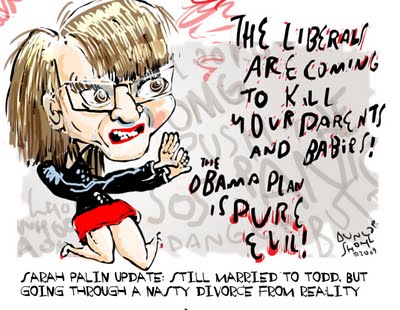
“The America I know and love is not one in which my parents or my baby with Down Syndrome will have to stand in front of Obama’s “death panel” so his bureaucrats can decide, based on a subjective judgment of their “level of productivity in society,” whether they are worthy of health care. Such a system is downright evil.”

As weirdly elitist as this:

“I commend her for being a voice for the most precious members of our society, our children and our seniors.”

And as “grab your torches and pitch forks” this is:

“Let’s stop and think and make our voices heard before it’s too late.”

there is a much bigger problem.  Sarah Palin has a history of fudging about health care.

While being vetted by the McCain camp:

At one point, trying out a debating point that she believed showed she could empathize with uninsured Americans, Palin told McCain aides that she and Todd in the early years of their marriage had been unable to afford health insurance of any kind, and had gone without it until he got his union card and went to work for British Petroleum on the North Slope of Alaska. Checking with Todd Palin himself revealed that, no, they had had catastrophic coverage all along. She insisted that catastrophic insurance didn’t really count and need not be revealed. This sort of slipperiness—about both what the truth was and whether the truth even mattered—persisted on questions great and small.

During the vice-presidential debate, Palin stated:

About times and Todd and our marriage in our past where we didn’t have health insurance and we know what other Americans are going through as they sit around the kitchen table and try to figure out how are they going to pay out-of-pocket for health care? We’ve been there also so that connection was important.

WHAT? There are 228 federally recognized tribes in Alaska.  According to the Indian Health Services website:

IHS-funded, tribally-managed hospitals are located in Anchorage, Barrow, Bethel, Dillingham, Kotzebue, Nome and Sitka. There are 37 tribal health centers, 166 tribal community health aide clinics and five residential substance abuse treatment centers. The Alaska Native Medical Center in Anchorage is the state-wide referral center and gatekeeper for specialty care. Other health promotion/disease prevention programs that are state-wide in scope are operated by the Alaska Native Tribal Health Consortium (ANTHC), which is managed by representatives of all Alaska tribes.

Todd Palin’s heritage as an Alaskan Native was a curiosity to many during the 2008 campaign.

According to public disclosure forms that Sarah Palin filed with the state of Alaska, her husband and their children are BBNC (Bristol Bay Native Corporation) shareholders, meaning they would likely qualify for the health service program.

So between Todd’s union job insurance, the governor’s state coverage and the FEDERALLY FUNDED health care through Native blood, when did the Palins ever sit around the kitchen table and discuss their “out-of-pocket” health care costs?   There are millions of people who don’t have ANY options to provide for the health care needs of themselves or their children, let alone THREE!

And that’s just the personal hypocrisy.

While under contract to govern the state of Alaska, Palin’s administration failed to keep up on the state’s Medicaid obligations and were ordered to cease signing up new patients. No other state in the country had been put under such a moratorium, according to the federal Centers for Medicare & Medicaid Services.

July 14, 2009 ADN:

A particularly alarming finding concerns deaths of adults in the programs. In one 2 1/2 year stretch, 227 adults already getting services died while waiting for a nurse to reassess their needs. Another 27 died waiting for their initial assessment, to see if they qualified for help.

Doctors and other health care providers wrote to the Centers for Medicare & Medicaid with concerns that the state wasn’t responsive. Some alleged that the lack of state controls “has resulted in the death(s) of the active clients,” the federal review said.

While the people served are frail and suffer from chronic health issues, the state never investigated to determine if any failure in service contributed to the deaths, the federal review found.

Seriously, when are we going to stop electing people who say “the government is bad”? Once elected, they do everything they can to prove it.  It can only be one of two things; incompetency or sabotage.  Either way, Alaskans have died due to a lack of health care.

The point of this post is not to point out the never ending hypocrisy of Sarah Palin.  Nor is it to point out the blatant lies of one person — but how the intention, manipulation and lies of one person can affect the lives ordinary people.

Perhaps Citizen Palin should take her own advice, “honor the American soldier”, “quit makin’ things up” and “leave the kids alone.”

smdivorcerealityAlaskan cartoonist Peter Dunlap Shohl.

Posted in Sarah Palin, Shannyn Moore, Uncategorized | Tags: "death panel", face book, health care, IHS, mccain, Michele Bachmann, palin, vice presidential debate, wack a mole

“Death Panels” For Dummies « SHANNYN MOORE: JUST A GIRL FROM HOMER

How debit cards fleece consumers

A 1,000% fee just for buying a fast-food burger? In our shift to a cashless society, the banking industry has evolved from our financial servant to our master.

[Related content: banking, financial privacy, debit cards, credit cards, credit card fees]

By Chris Pummer, MarketWatch

Born-again Democrats recently made a big to-do in reining in credit card industry abuses. To really safeguard our interests, the new U.S. Consumer Financial Protection Agency now needs to halt the banking industry's coup in progress and the means of its power grab: the debit card.

Being able to whip out a debit card for virtually any transaction is so convenient. Yet in promoting our evolution to a cashless society, banks have commandeered and privatized the nation's payment system, and they profit mightily on all types of purchases, down to buying a candy bar.

>Find more on debit cards.

Find more on debit cards.

The industry's initial aim was to reduce cash-handling, check-clearing and accounting costs via electronic transactions, including direct deposit of paychecks and automatic withdrawals for bills and expenses.

Its ultimate windfall: While reaping those savings, it now generates billions in fee-based income -- and we've all sacrificed financial privacy in ways we've not yet even begun to fathom.

Used to be debit card purchases wouldn't go through without sufficient funds in a cardholder's account. Then opportunistic banks realized that, with direct deposit, they could recoup the overdrawn funds the instant their clients' next payroll checks rolled in.

The upshot: Banks may impose a $35 fee for "overdrawing" on a $3.50 fast-food purchase -- and have vigorously fought efforts to provide electronic warning of the debit card overdraft at the point of sale. The equivalent interest rate for your $3.50 lapse: 1,000%.

Here's more to consider:

The double standard on account theft. Credit card holders aren't on the hook for fraudulent use of their card numbers and can challenge charges on goods and services not delivered as promised. Debit card holders aren't guaranteed those same protections.

The reason: It's the lenders' money on the line with a credit card transaction -- and just our hard-earned savings with debit card fraud. They'll absorb the cost of investigating and prosecuting theft of their money, but they don't want to pick up the cost of policing the theft of ours -- by identical means through their very same hands.

Credit card borrowers are never out more than $50 regardless of when they discover potential fraud. Debit card holders' liability is limited to $50 only if they report perceived fraud within two days; the liability jumps to a maximum $500 from that point to 60 days and is unlimited thereafter.

Vanishing gift-card balances. When consumers buy gift cards, they essentially give retailers an interest-free loan until the recipient uses the card, rather generous when you think about it. Yet on many cards, in small print, is the caveat that the card's value is wiped out if not used by a certain date.

What the hell? Cash value should never vanish, whether in hand or in stored electronic chits. Whoever let our payment system get boarded by Somali pirates?

(This is already illegal in some states. See your state's rules.)

Video on MSN Money

The new credit card landscape © CNBC

The new credit card landscape
CNBC's Bertha Combs looks at the shock waves the new rules will send through the card industry.

How we got snookered

The Federal Reserve under Alan Greenspan championed the banks' aims, since it cost the Fed a nickel to process checks through its transfer system versus a penny for electronic transactions. To Greenspan, the cost savings for the Fed justified the unprecedented turnover of the payment system to the banks.

The IRS, meanwhile, loved the personal record the shift to a cashless society produces because it reduces the undocumented flow of cash through the "underground economy." We've improved the likelihood the government will collect on taxes owed, but at what societal cost?

Continued: The demise of financial self-discipline

The debit card's predecessor, of course, was the ATM card, whose initial selfish aim was to eliminate the need for bank tellers and associated labor costs. We gained access to cash after banking hours in the 1980s and -- thanks to direct deposit -- never had to wait in long lines during Friday lunch hour to cash payroll checks. How great was that!

Thus began our drunkenness on electronic transactions and the demise of our financial self-discipline as we too liberally dispense with our limited savings simply because they're so readily accessible. That's just as the banks intended when they shifted from making money off how they invested our deposits, and began vigorously promoting our spending for the fees it generated.

Debit card practices now need some immediate curbs to turn the banking industry back into our financial servant rather than our master:

  • Notice of deficient funds. Realizing its debit card overdraft fees are blatantly usurious, the banking industry has been open lately to possibly letting account holders "opt out" of the ability to overdraw accounts. Consumer advocates want the policy to instead be "opt in," meaning account holders have to agree to accept overdraft levies. The simple compromise: Notify cardholders at the moment of transaction that they'll be overdrawn and let them decide whether they want to pay the fee or cancel the transaction.
  • Same theft protections as credit cards. Whether it's their money on the line or our own, banks must afford debit card transactions the same theft protection they do for credit cards.
  • An outright ban on a dangerous ''next-gen" card. When retailers ask "credit or debit," it's merely a question of how consumers want the transaction processed; the funds still come out of their bank accounts. What must be banned outright: allowing banks to offer a single, combined debit and credit card that defaults to the latter if there are insufficient funds in one's bank account. That would be the industry's Holy Grail, and we can't let them hand us that arsenic-laden cup.

Video on MSN Money

The new credit card landscape © CNBC

The new credit card landscape
CNBC's Bertha Combs looks at the shock waves the new rules will send through the card industry.

America's entire payment system needs immediate scrutiny and reform to map out where it's headed. If not, we might as well cede the future of the world to the burgeoning Chinese middle class, which isn't likely to blow banked, hard-earned yuan in an instant just because it has the ability to do so.

That effort will fall to the Consumer Financial Protection Agency, which will take over regulation of consumer-lending products and practices now overseen by various federal banking regulators, if Congress passes current legislation.

The rub: The primary focus of those banking regulators -- which are funded and lobbied hard by the banks -- is ensuring banks' safety and soundness, and we've seen what a great job they did there. It's now time for federal authorities to look out more for the safety and soundness of our modest little accounts.

Chris Pummer is a former senior editor for MarketWatch and Bloomberg News and a reporter for such papers as the Los Angeles Times and San Jose Mercury News.

Published Aug. 7, 2009

Friday, August 28, 2009

The Neantrathals have returned!

And they need to be driven back into their caves!!!!
Last night we were pleasured by some of these folks in their diatribe against sensible health care reform.  Posing as a national journalist and some weak-kneed medical professionals (?) they propagated the usual lies of the wing-nut crowd.
I think its time for the enlightened majority to shout these Luddites back into the obscurity they deserve.

Pastor Of Gun-Toter At Obama Event Prayed For Obama To Die | TPMMuckraker


Pastor Of Gun-Toter At Obama Event Prayed For Obama To Die | TPMMuckraker

Thursday, August 27, 2009

MoveOn.org Political Action: Democracy in Action
The Dream
Shall Never Die


Ted Kennedy on Health Care

Wednesday, August 26, 2009

I sure hope its the opponents to sensible national health care who are the first to enjoy the panic that comes from a medical diagnosis that their precious 'private' insurance company denies coverage for... 
Or...that they are the chosen ones who loose their jobs (and subsequently their primier coverage) about the same time they begin to get too old to find comparable employment and insurance coverage.
What greater justice would that be!

Monday, August 24, 2009

Friday, August 21, 2009

Op-Ed Columnist - Obama’s Trust Problem - NYTimes.com


August 21, 2009

Op-Ed Columnist

Obama’s Trust Problem

By PAUL KRUGMAN

According to news reports, the Obama administration — which seemed, over the weekend, to be backing away from the “public option” for health insurance — is shocked and surprised at the furious reaction from progressives.

Well, I’m shocked and surprised at their shock and surprise.

A backlash in the progressive base — which pushed President Obama over the top in the Democratic primary and played a major role in his general election victory — has been building for months. The fight over the public option involves real policy substance, but it’s also a proxy for broader questions about the president’s priorities and overall approach.

The idea of letting individuals buy insurance from a government-run plan was introduced in 2007 by Jacob Hacker of Yale, was picked up by John Edwards during the Democratic primary, and became part of the original Obama health care plan.

One purpose of the public option is to save money. Experience with Medicare suggests that a government-run plan would have lower costs than private insurers; in addition, it would introduce more competition and keep premiums down.

And let’s be clear: the supposed alternative, nonprofit co-ops, is a sham. That’s not just my opinion; it’s what the market says: stocks of health insurance companies soared on news that the Gang of Six senators trying to negotiate a bipartisan approach to health reform were dropping the public plan. Clearly, investors believe that co-ops would offer little real competition to private insurers.

Also, and importantly, the public option offered a way to reconcile differing views among Democrats. Until the idea of the public option came along, a significant faction within the party rejected anything short of true single-payer, Medicare-for-all reform, viewing anything less as perpetuating the flaws of our current system. The public option, which would force insurance companies to prove their usefulness or fade away, settled some of those qualms.

That said, it’s possible to have universal coverage without a public option — several European nations do it — and some who want a public option might be willing to forgo it if they had confidence in the overall health care strategy. Unfortunately, the president’s behavior in office has undermined that confidence.

On the issue of health care itself, the inspiring figure progressives thought they had elected comes across, far too often, as a dry technocrat who talks of “bending the curve” but has only recently begun to make the moral case for reform. Mr. Obama’s explanations of his plan have gotten clearer, but he still seems unable to settle on a simple, pithy formula; his speeches and op-eds still read as if they were written by a committee.

Meanwhile, on such fraught questions as torture and indefinite detention, the president has dismayed progressives with his reluctance to challenge or change Bush administration policy.

And then there’s the matter of the banks.

I don’t know if administration officials realize just how much damage they’ve done themselves with their kid-gloves treatment of the financial industry, just how badly the spectacle of government supported institutions paying giant bonuses is playing. But I’ve had many conversations with people who voted for Mr. Obama, yet dismiss the stimulus as a total waste of money. When I press them, it turns out that they’re really angry about the bailouts rather than the stimulus — but that’s a distinction lost on most voters.

So there’s a growing sense among progressives that they have, as my colleague Frank Rich suggests, been punked. And that’s why the mixed signals on the public option created such an uproar.

Now, politics is the art of the possible. Mr. Obama was never going to get everything his supporters wanted.

But there’s a point at which realism shades over into weakness, and progressives increasingly feel that the administration is on the wrong side of that line. It seems as if there is nothing Republicans can do that will draw an administration rebuke: Senator Charles E. Grassley feeds the death panel smear, warning that reform will “pull the plug on grandma,” and two days later the White House declares that it’s still committed to working with him.

It’s hard to avoid the sense that Mr. Obama has wasted months trying to appease people who can’t be appeased, and who take every concession as a sign that he can be rolled.

Indeed, no sooner were there reports that the administration might accept co-ops as an alternative to the public option than G.O.P. leaders announced that co-ops, too, were unacceptable.

So progressives are now in revolt. Mr. Obama took their trust for granted, and in the process lost it. And now he needs to win it back.

Op-Ed Columnist - Obama’s Trust Problem - NYTimes.com

Friday, August 14, 2009

Op-Ed Columnist - Republican Death Trip - NYTimes.com
August 14, 2009
Op-Ed Columnist
Republican Death Trip
By PAUL KRUGMAN

“I am in this race because I don’t want to see us spend the next year re-fighting the Washington battles of the 1990s. I don’t want to pit Blue America against Red America; I want to lead a United States of America.” So declared Barack Obama in November 2007, making the case that Democrats should nominate him, rather than one of his rivals, because he could free the nation from the bitter partisanship of the past.

Some of us were skeptical. A couple of months after Mr. Obama gave that speech, I warned that his vision of a “different kind of politics” was a vain hope, that any Democrat who made it to the White House would face “an unending procession of wild charges and fake scandals, dutifully given credence by major media organizations that somehow can’t bring themselves to declare the accusations unequivocally false.”

So, how’s it going?

Sure enough, President Obama is now facing the same kind of opposition that President Bill Clinton had to deal with: an enraged right that denies the legitimacy of his presidency, that eagerly seizes on every wild rumor manufactured by the right-wing media complex.

This opposition cannot be appeased. Some pundits claim that Mr. Obama has polarized the country by following too liberal an agenda. But the truth is that the attacks on the president have no relationship to anything he is actually doing or proposing.

Right now, the charge that’s gaining the most traction is the claim that health care reform will create “death panels” (in Sarah Palin’s words) that will shuffle the elderly and others off to an early grave. It’s a complete fabrication, of course. The provision requiring that Medicare pay for voluntary end-of-life counseling was introduced by Senator Johnny Isakson, Republican — yes, Republican — of Georgia, who says that it’s “nuts” to claim that it has anything to do with euthanasia.

And not long ago, some of the most enthusiastic peddlers of the euthanasia smear, including Newt Gingrich, the former speaker of the House, and Mrs. Palin herself, were all for “advance directives” for medical care in the event that you are incapacitated or comatose. That’s exactly what was being proposed — and has now, in the face of all the hysteria, been dropped from the bill.

Yet the smear continues to spread. And as the example of Mr. Gingrich shows, it’s not a fringe phenomenon: Senior G.O.P. figures, including so-called moderates, have endorsed the lie.

Senator Chuck Grassley, Republican of Iowa, is one of these supposed moderates. I’m not sure where his centrist reputation comes from — he did, after all, compare critics of the Bush tax cuts to Hitler. But in any case, his role in the health care debate has been flat-out despicable.

Last week, Mr. Grassley claimed that his colleague Ted Kennedy’s brain tumor wouldn’t have been treated properly in other countries because they prefer to “spend money on people who can contribute more to the economy.” This week, he told an audience that “you have every right to fear,” that we “should not have a government-run plan to decide when to pull the plug on grandma.”

Again, that’s what a supposedly centrist Republican, a member of the Gang of Six trying to devise a bipartisan health plan, sounds like.

So much, then, for Mr. Obama’s dream of moving beyond divisive politics. The truth is that the factors that made politics so ugly in the Clinton years — the paranoia of a significant minority of Americans and the cynical willingness of leading Republicans to cater to that paranoia — are as strong as ever. In fact, the situation may be even worse than it was in the 1990s because the collapse of the Bush administration has left the G.O.P. with no real leaders other than Rush Limbaugh.

The question now is how Mr. Obama will deal with the death of his postpartisan dream.

So far, at least, the Obama administration’s response to the outpouring of hate on the right has had a deer-in-the-headlights quality. It’s as if officials still can’t wrap their minds around the fact that things like this can happen to people who aren’t named Clinton, as if they keep expecting the nonsense to just go away.

What, then, should Mr. Obama do? It would certainly help if he gave clearer and more concise explanations of his health care plan. To be fair, he’s gotten much better at that over the past couple of weeks.

What’s still missing, however, is a sense of passion and outrage — passion for the goal of ensuring that every American gets the health care he or she needs, outrage at the lies and fear-mongering that are being used to block that goal.

So can Mr. Obama, who can be so eloquent when delivering a message of uplift, rise to the challenge of unreasoning, unappeasable opposition? Only time will tell.


Monday, August 10, 2009

Op-Ed Columnist - Averting the Worst - NYTimes.com
The New York Times
Printer Friendly Format Sponsored By

August 10, 2009
Op-Ed Columnist
Averting the Worst
By PAUL KRUGMAN

So it seems that we aren’t going to have a second Great Depression after all. What saved us? The answer, basically, is Big Government.

Just to be clear: the economic situation remains terrible, indeed worse than almost anyone thought possible not long ago. The nation has lost 6.7 million jobs since the recession began. Once you take into account the need to find employment for a growing working-age population, we’re probably around nine million jobs short of where we should be.

And the job market still hasn’t turned around — that slight dip in the measured unemployment rate last month was probably a statistical fluke. We haven’t yet reached the point at which things are actually improving; for now, all we have to celebrate are indications that things are getting worse more slowly.

For all that, however, the latest flurry of economic reports suggests that the economy has backed up several paces from the edge of the abyss.

A few months ago the possibility of falling into the abyss seemed all too real. The financial panic of late 2008 was as severe, in some ways, as the banking panic of the early 1930s, and for a while key economic indicators — world trade, world industrial production, even stock prices — were falling as fast as or faster than they did in 1929-30.

But in the 1930s the trend lines just kept heading down. This time, the plunge appears to be ending after just one terrible year.

So what saved us from a full replay of the Great Depression? The answer, almost surely, lies in the very different role played by government.

Probably the most important aspect of the government’s role in this crisis isn’t what it has done, but what it hasn’t done: unlike the private sector, the federal government hasn’t slashed spending as its income has fallen. (State and local governments are a different story.) Tax receipts are way down, but Social Security checks are still going out; Medicare is still covering hospital bills; federal employees, from judges to park rangers to soldiers, are still being paid.

All of this has helped support the economy in its time of need, in a way that didn’t happen back in 1930, when federal spending was a much smaller percentage of G.D.P. And yes, this means that budget deficits — which are a bad thing in normal times — are actually a good thing right now.

In addition to having this “automatic” stabilizing effect, the government has stepped in to rescue the financial sector. You can argue (and I would) that the bailouts of financial firms could and should have been handled better, that taxpayers have paid too much and received too little. Yet it’s possible to be dissatisfied, even angry, about the way the financial bailouts have worked while acknowledging that without these bailouts things would have been much worse.

The point is that this time, unlike in the 1930s, the government didn’t take a hands-off attitude while much of the banking system collapsed. And that’s another reason we’re not living through Great Depression II.

Last and probably least, but by no means trivial, have been the deliberate efforts of the government to pump up the economy. From the beginning, I argued that the American Recovery and Reinvestment Act, a k a the Obama stimulus plan, was too small. Nonetheless, reasonable estimates suggest that around a million more Americans are working now than would have been employed without that plan — a number that will grow over time — and that the stimulus has played a significant role in pulling the economy out of its free fall.

All in all, then, the government has played a crucial stabilizing role in this economic crisis. Ronald Reagan was wrong: sometimes the private sector is the problem, and government is the solution.

And aren’t you glad that right now the government is being run by people who don’t hate government?

We don’t know what the economic policies of a McCain-Palin administration would have been. We do know, however, what Republicans in opposition have been saying — and it boils down to demanding that the government stop standing in the way of a possible depression.

I’m not just talking about opposition to the stimulus. Leading Republicans want to do away with automatic stabilizers, too. Back in March, John Boehner, the House minority leader, declared that since families were suffering, "it’s time for government to tighten their belts and show the American people that we ‘get’ it." Fortunately, his advice was ignored.

I’m still very worried about the economy. There’s still, I fear, a substantial chance that unemployment will remain high for a very long time. But we appear to have averted the worst: utter catastrophe no longer seems likely.

And Big Government, run by people who understand its virtues, is the reason why.

Home

* World
* U.S.
* N.Y. / Region
* Business
* Technology
* Science
* Health
* Sports
* Opinion
* Arts
* Style
* Travel
* Jobs
* Real Estate
* Automobiles
* Back to Top

Copyright 2009 The New York Times Company

* Privacy Policy
* Terms of Service
* Search
* Corrections
* RSS
* First Look
* Help
* Contact Us
* Work for Us
* Site Map


Sunday, August 9, 2009

Op-Ed Contributor - Is It Now a Crime to Be Poor? - NYTimes.com
The New York Times
Printer Friendly Format Sponsored By

August 9, 2009
Op-Ed Contributor
Is It Now a Crime to Be Poor?
By BARBARA EHRENREICH

IT’S too bad so many people are falling into poverty at a time when it’s almost illegal to be poor. You won’t be arrested for shopping in a Dollar Store, but if you are truly, deeply, in-the-streets poor, you’re well advised not to engage in any of the biological necessities of life — like sitting, sleeping, lying down or loitering. City officials boast that there is nothing discriminatory about the ordinances that afflict the destitute, most of which go back to the dawn of gentrification in the ’80s and ’90s. “If you’re lying on a sidewalk, whether you’re homeless or a millionaire, you’re in violation of the ordinance,” a city attorney in St. Petersburg, Fla., said in June, echoing Anatole France’s immortal observation that “the law, in its majestic equality, forbids the rich as well as the poor to sleep under bridges.”

In defiance of all reason and compassion, the criminalization of poverty has actually been intensifying as the recession generates ever more poverty. So concludes a new study from the National Law Center on Homelessness and Poverty, which found that the number of ordinances against the publicly poor has been rising since 2006, along with ticketing and arrests for more “neutral” infractions like jaywalking, littering or carrying an open container of alcohol.

The report lists America’s 10 “meanest” cities — the largest of which are Honolulu, Los Angeles and San Francisco — but new contestants are springing up every day. The City Council in Grand Junction, Colo., has been considering a ban on begging, and at the end of June, Tempe, Ariz., carried out a four-day crackdown on the indigent. How do you know when someone is indigent? As a Las Vegas statute puts it, “An indigent person is a person whom a reasonable ordinary person would believe to be entitled to apply for or receive” public assistance.

That could be me before the blow-drying and eyeliner, and it’s definitely Al Szekely at any time of day. A grizzled 62-year-old, he inhabits a wheelchair and is often found on G Street in Washington — the city that is ultimately responsible for the bullet he took in the spine in Fu Bai, Vietnam, in 1972. He had been enjoying the luxury of an indoor bed until last December, when the police swept through the shelter in the middle of the night looking for men with outstanding warrants.

It turned out that Mr. Szekely, who is an ordained minister and does not drink, do drugs or curse in front of ladies, did indeed have a warrant — for not appearing in court to face a charge of “criminal trespassing” (for sleeping on a sidewalk in a Washington suburb). So he was dragged out of the shelter and put in jail. “Can you imagine?” asked Eric Sheptock, the homeless advocate (himself a shelter resident) who introduced me to Mr. Szekely. “They arrested a homeless man in a shelter for being homeless.”

The viciousness of the official animus toward the indigent can be breathtaking. A few years ago, a group called Food Not Bombs started handing out free vegan food to hungry people in public parks around the nation. A number of cities, led by Las Vegas, passed ordinances forbidding the sharing of food with the indigent in public places, and several members of the group were arrested. A federal judge just overturned the anti-sharing law in Orlando, Fla., but the city is appealing. And now Middletown, Conn., is cracking down on food sharing.

If poverty tends to criminalize people, it is also true that criminalization inexorably impoverishes them. Scott Lovell, another homeless man I interviewed in Washington, earned his record by committing a significant crime — by participating in the armed robbery of a steakhouse when he was 15. Although Mr. Lovell dresses and speaks more like a summer tourist from Ohio than a felon, his criminal record has made it extremely difficult for him to find a job.

For Al Szekely, the arrest for trespassing meant a further descent down the circles of hell. While in jail, he lost his slot in the shelter and now sleeps outside the Verizon Center sports arena, where the big problem, in addition to the security guards, is mosquitoes. His stick-thin arms are covered with pink crusty sores, which he treats with a regimen of frantic scratching.

For the not-yet-homeless, there are two main paths to criminalization — one involving debt, and the other skin color. Anyone of any color or pre-recession financial status can fall into debt, and although we pride ourselves on the abolition of debtors’ prison, in at least one state, Texas, people who can’t afford to pay their traffic fines may be made to “sit out their tickets” in jail.

Often the path to legal trouble begins when one of your creditors has a court issue a summons for you, which you fail to honor for one reason or another. (Maybe your address has changed or you never received it.) Now you’re in contempt of court. Or suppose you miss a payment and, before you realize it, your car insurance lapses; then you’re stopped for something like a broken headlight. Depending on the state, you may have your car impounded or face a steep fine — again, exposing you to a possible summons. “There’s just no end to it once the cycle starts,” said Robert Solomon of Yale Law School. “It just keeps accelerating.”

By far the most reliable way to be criminalized by poverty is to have the wrong-color skin. Indignation runs high when a celebrity professor encounters racial profiling, but for decades whole communities have been effectively “profiled” for the suspicious combination of being both dark-skinned and poor, thanks to the “broken windows” or “zero tolerance” theory of policing popularized by Rudy Giuliani, when he was mayor of New York City, and his police chief William Bratton.

Flick a cigarette in a heavily patrolled community of color and you’re littering; wear the wrong color T-shirt and you’re displaying gang allegiance. Just strolling around in a dodgy neighborhood can mark you as a potential suspect, according to “Let’s Get Free: A Hip-Hop Theory of Justice,” an eye-opening new book by Paul Butler, a former federal prosecutor in Washington. If you seem at all evasive, which I suppose is like looking “overly anxious” in an airport, Mr. Butler writes, the police “can force you to stop just to investigate why you don’t want to talk to them.” And don’t get grumpy about it or you could be “resisting arrest.”

There’s no minimum age for being sucked into what the Children’s Defense Fund calls “the cradle-to-prison pipeline.” In New York City, a teenager caught in public housing without an ID — say, while visiting a friend or relative — can be charged with criminal trespassing and wind up in juvenile detention, Mishi Faruqee, the director of youth justice programs for the Children’s Defense Fund of New York, told me. In just the past few months, a growing number of cities have taken to ticketing and sometimes handcuffing teenagers found on the streets during school hours.

In Los Angeles, the fine for truancy is $250; in Dallas, it can be as much as $500 — crushing amounts for people living near the poverty level. According to the Los Angeles Bus Riders Union, an advocacy group, 12,000 students were ticketed for truancy in 2008.

Why does the Bus Riders Union care? Because it estimates that 80 percent of the “truants,” especially those who are black or Latino, are merely late for school, thanks to the way that over-filled buses whiz by them without stopping. I met people in Los Angeles who told me they keep their children home if there’s the slightest chance of their being late. It’s an ingenious anti-truancy policy that discourages parents from sending their youngsters to school.

The pattern is to curtail financing for services that might help the poor while ramping up law enforcement: starve school and public transportation budgets, then make truancy illegal. Shut down public housing, then make it a crime to be homeless. Be sure to harass street vendors when there are few other opportunities for employment. The experience of the poor, and especially poor minorities, comes to resemble that of a rat in a cage scrambling to avoid erratically administered electric shocks.

And if you should make the mistake of trying to escape via a brief marijuana-induced high, it’s “gotcha” all over again, because that of course is illegal too. One result is our staggering level of incarceration, the highest in the world. Today the same number of Americans — 2.3 million — reside in prison as in public housing.

Meanwhile, the public housing that remains has become ever more prisonlike, with residents subjected to drug testing and random police sweeps. The safety net, or what’s left of it, has been transformed into a dragnet.

Some of the community organizers I’ve talked to around the country think they know why “zero tolerance” policing has ratcheted up since the recession began. Leonardo Vilchis of the Union de Vecinos, a community organization in Los Angeles, suspects that “poor people have become a source of revenue” for recession-starved cities, and that the police can always find a violation leading to a fine. If so, this is a singularly demented fund-raising strategy. At a Congressional hearing in June, the president of the National Association of Criminal Defense Lawyers testified about the pervasive “overcriminalization of crimes that are not a risk to public safety,” like sleeping in a cardboard box or jumping turnstiles, which leads to expensively clogged courts and prisons.

A Pew Center study released in March found states spending a record $51.7 billion on corrections, an amount that the center judged, with an excess of moderation, to be “too much.”

But will it be enough — the collision of rising prison populations that we can’t afford and the criminalization of poverty — to force us to break the mad cycle of poverty and punishment? With the number of people in poverty increasing (some estimates suggest it’s up to 45 million to 50 million, from 37 million in 2007) several states are beginning to ease up on the criminalization of poverty — for example, by sending drug offenders to treatment rather than jail, shortening probation and reducing the number of people locked up for technical violations like missed court appointments. But others are tightening the screws: not only increasing the number of “crimes” but also charging prisoners for their room and board — assuring that they’ll be released with potentially criminalizing levels of debt.

Maybe we can’t afford the measures that would begin to alleviate America’s growing poverty — affordable housing, good schools, reliable public transportation and so forth. I would argue otherwise, but for now I’d be content with a consensus that, if we can’t afford to truly help the poor, neither can we afford to go on tormenting them.

Barbara Ehrenreich is the author, most recently, of “This Land Is Their Land: Reports From a Divided Nation.”

Home

* World
* U.S.
* N.Y. / Region
* Business
* Technology
* Science
* Health
* Sports
* Opinion
* Arts
* Style
* Travel
* Jobs
* Real Estate
* Automobiles
* Back to Top

Copyright 2009 The New York Times Company

* Privacy Policy
* Terms of Service
* Search
* Corrections
* RSS
* First Look
* Help
* Contact Us
* Work for Us
* Site Map


Friday, August 7, 2009

Op-Ed Columnist - The Town Hall Mob - NYTimes.com


August 7, 2009

Op-Ed Columnist

The Town Hall Mob

By PAUL KRUGMAN

There’s a famous Norman Rockwell painting titled “Freedom of Speech,” depicting an idealized American town meeting. The painting, part of a series illustrating F.D.R.’s “Four Freedoms,” shows an ordinary citizen expressing an unpopular opinion. His neighbors obviously don’t like what he’s saying, but they’re letting him speak his mind.

That’s a far cry from what has been happening at recent town halls, where angry protesters — some of them, with no apparent sense of irony, shouting “This is America!” — have been drowning out, and in some cases threatening, members of Congress trying to talk about health reform.

Some commentators have tried to play down the mob aspect of these scenes, likening the campaign against health reform to the campaign against Social Security privatization back in 2005. But there’s no comparison. I’ve gone through many news reports from 2005, and while anti-privatization activists were sometimes raucous and rude, I can’t find any examples of congressmen shouted down, congressmen hanged in effigy, congressmen surrounded and followed by taunting crowds.

And I can’t find any counterpart to the death threats at least one congressman has received.

So this is something new and ugly. What’s behind it?

Robert Gibbs, the White House press secretary, has compared the scenes at health care town halls to the “Brooks Brothers riot” in 2000 — the demonstration that disrupted the vote count in Miami and arguably helped send George W. Bush to the White House. Portrayed at the time as local protesters, many of the rioters were actually G.O.P. staffers flown in from Washington.

But Mr. Gibbs is probably only half right. Yes, well-heeled interest groups are helping to organize the town hall mobs. Key organizers include two Astroturf (fake grass-roots) organizations: FreedomWorks, run by the former House majority leader Dick Armey, and a new organization called Conservatives for Patients’ Rights.

The latter group, by the way, is run by Rick Scott, the former head of Columbia/HCA, a for-profit hospital chain. Mr. Scott was forced out of that job amid a fraud investigation; the company eventually pleaded guilty to charges of overbilling state and federal health plans, paying $1.7 billion — yes, that’s “billion” — in fines. You can’t make this stuff up.

But while the organizers are as crass as they come, I haven’t seen any evidence that the people disrupting those town halls are Florida-style rent-a-mobs. For the most part, the protesters appear to be genuinely angry. The question is, what are they angry about?

There was a telling incident at a town hall held by Representative Gene Green, D-Tex. An activist turned to his fellow attendees and asked if they “oppose any form of socialized or government-run health care.” Nearly all did. Then Representative Green asked how many of those present were on Medicare. Almost half raised their hands.

Now, people who don’t know that Medicare is a government program probably aren’t reacting to what President Obama is actually proposing. They may believe some of the disinformation opponents of health care reform are spreading, like the claim that the Obama plan will lead to euthanasia for the elderly. (That particular claim is coming straight from House Republican leaders.) But they’re probably reacting less to what Mr. Obama is doing, or even to what they’ve heard about what he’s doing, than to who he is.

That is, the driving force behind the town hall mobs is probably the same cultural and racial anxiety that’s behind the “birther” movement, which denies Mr. Obama’s citizenship. Senator Dick Durbin has suggested that the birthers and the health care protesters are one and the same; we don’t know how many of the protesters are birthers, but it wouldn’t be surprising if it’s a substantial fraction.

And cynical political operators are exploiting that anxiety to further the economic interests of their backers.

Does this sound familiar? It should: it’s a strategy that has played a central role in American politics ever since Richard Nixon realized that he could advance Republican fortunes by appealing to the racial fears of working-class whites.

Many people hoped that last year’s election would mark the end of the “angry white voter” era in America. Indeed, voters who can be swayed by appeals to cultural and racial fear are a declining share of the electorate.

But right now Mr. Obama’s backers seem to lack all conviction, perhaps because the prosaic reality of his administration isn’t living up to their dreams of transformation. Meanwhile, the angry right is filled with a passionate intensity.

And if Mr. Obama can’t recapture some of the passion of 2008, can’t inspire his supporters to stand up and be heard, health care reform may well fail.

Op-Ed Columnist - The Town Hall Mob - NYTimes.com

Thursday, August 6, 2009

Taco Bell's New Green Menu Takes No Ingredients From Nature | The Onion - America's Finest News Source


Taco Bell's New Green Menu Takes No Ingredients From Nature | The Onion - America's Finest News Source

Monday, August 3, 2009


Mr. Deity Episode 9: Mr. Deity and the Book

Sunday, August 2, 2009

Editorial - Curbing Runaway Health Inflation - NYTimes.com


August 2, 2009

Editorial

Curbing Runaway Health Inflation

This year’s effort to reform health care revolves around two powerful, conflicting imperatives. One is to cover tens of millions of uninsured Americans. The other is to absorb the enormous cost of that plan — which could reach $1 trillion over 10 years — without increasing the budget deficit in the next decade or setting the nation on a course that will drive up deficits later.

It is easier to see how to accomplish the first task than the second. But Congress should not slow the push for near-universal coverage while it looks for ways to apply the brakes to the growth in costs. We can be virtually certain that the reforms enacted will be deficit-neutral over the first 10 years. President Obama and Democratic leaders will find cuts in Medicare and raise sufficient taxes to offset the initial cost of insurance expansion.

It is much harder to find ways to slow inflation in health care costs. Peter Orszag, Mr. Obama’s budget director, has been searching for what he calls “game changers” that can “bend down the cost curve” in coming years. The question is how well he and Congressional champions of health care reform have succeeded.

WHY IT’S IMPORTANT The skyrocketing cost of health care is driving up federal deficits, threatening to bankrupt Medicare, forcing employers to cut or drop benefits, and leaving workers and their families with unaffordable bills. Even a relatively small reduction in the average annual growth rate over the next decade — from, say, 6.2 percent to 4.7 percent — could save more than $2 trillion for the health care system and hundreds or thousands of dollars for the average family. There is an enormous amount of money in the health care system, much of it spent on tests and procedures that do not improve health. It should be possible to wring out some of that spending.

HOW CAN WE JUDGE SUCCESS? Douglas Elmendorf, director of the Congressional Budget Office, testified in mid-July that he saw no fundamental changes offered by the bills then emerging that would reduce the trajectory of federal health spending significantly. The implication was that the pending bills could actually make deficits bigger after the initial break-even decade. That’s because covering the uninsured would increase federal spending and a high rate of medical inflation applied to that larger base would make future deficits worse. However, Mr. Elmendorf was looking only at bills that had cleared committees, which did not include one still being fashioned by the pivotal Senate Finance Committee.

Senator Max Baucus, the Democrat who heads that committee, revealed last week that the C.B.O. had evaluated a draft of his bill and concluded that it would cover 95 percent of all Americans, for a cost below $900 billion, and would actually start reducing the deficit in 2019. That is better than the administration’s goal of being deficit-neutral in that final year, but we will not know for sure until the C.B.O. issues a verdict on a final bill.

The budget office provides vitally important guidance to Congress, but focuses primarily on how new legislation might affect federal spending and federal deficits. The office gives only a cursory glance at how reforms might cut costs for the overall system and yield savings for employers, families and state and local governments, the issue that concerns most people.

Moreover, the office makes middle-of-the road estimates of cost and more pessimistic estimates of savings. That makes sense (lawmakers and government agencies routinely exaggerate the virtues of their proposals), but it makes it harder to evaluate proposed innovations.

Respected analysts who are not bound by the C.B.O.’s conservatism have projected significant savings from reforms that the C.B.O. scores poorly. The Commonwealth Fund, a research organization, and David Cutler, a Harvard health economist, separately estimate that an array of reforms could save the government hundreds of billions of dollars in the first decade and the health care system even more. These estimates, coming from advocates of reform, may be too rosy, but underscore the point that the C.B.O. may undervalue savings.

POTENTIAL GAME CHANGERS It seems hard to believe that over the long haul the introduction of electronic medical records will not save substantial money. It would help eliminate the costly repetition of tests, and prevent medication errors that harm patients and lead to costly hospitalization. But it takes money to get started (Mr. Obama’s stimulus package calls for $50 billion over five years) and time to overcome physicians’ reluctance. Savings in the first decade, if any, are likely to be small.

So, too, it seems likely that a stimulus investment of $1.1 billion in comparative effectiveness research to gauge which medicines and procedures work best is likely to pay off in future decades.

The approach has been wrongly portrayed as an effort by government bureaucrats to dictate “cookbook” medicine that will prevent doctors from doing what’s best for their patients and lead to rationing of care. More than 60 physicians’ groups have urged Congress to make comparative effectiveness research an important component of reform. They believe the information would help doctors and patients understand which treatments work best. In some cases, the better treatments might be more expensive, in others less. Either way, patients benefit.

And so it goes, through such ideas as changing Medicare’s payment incentives to encourage better care not just more care, and to encourage new arrangements of doctors and hospitals that might control costs and provide more coordinated care than the fee-for-service system does. All will take time to bear fruit.

TAXES One way to keep deficits in check would be to impose taxes within the health care system instead of more broadly, which should ensure that revenues increase at the rate of health care inflation. A tax on the value of an employer’s contribution to insurance could lead beneficiaries to choose cheaper policies and think twice before undergoing costly tests. We have been leery of recommending a tax that would affect many workers, but a tax on very expensive plans might make sense.

OTHER IDEAS The administration seems to have scoured the health policy literature for ideas, and its proposals reflect the thinking of the nation’s leading experts. Most of these ideas would first be tried on a small scale in Medicare — to see if they reduced costs while improving or at least maintaining the quality of care — before being adopted on a wide scale in government programs. Ideas that work for Medicare would presumably migrate out to the private sector.

We believe that some of the reforms in pending legislation could be strengthened. Both public and private insurance plans, for example, should be allowed — not forbidden — to base reimbursement policies on comparative effectiveness findings. But for the most part, the nation is embarking on a long-term experiment to see what works, so small-scale tests and pilot programs seem appropriate.

THE OVERSEER With so much uncertainty, it seems imperative to ensure that the government can change course rapidly to drop approaches that do not work and expand approaches that do. Proposals have been made to create an independent commission of experts, responsible to either the president or Congress, to perform this function at a step removed from the distorting influences of political lobbying.

It is a good idea, if the commission has sufficient power and resources to do an effective job. The panel should be directed to pursue both cost reduction and quality improvement. It should be given cost reduction targets to meet and a mandate to impose across-the-board cuts in Medicare if it falls short. It should have sufficient resources to evaluate and sponsor studies, a membership beholden to no special interest, and be insulated from political pressure by requiring Congress to approve or reject recommendations as a package, without fighting over individual items of interest to lobbyists.

WRONG-HEADED CRITICISM The Republican Party has started a campaign charging that President Obama is conducting a dangerous and reckless experiment in health care reform that will damage the economy, kill jobs, drive up health care costs, and harm patients. That is a bit hard to take after the Bush administration’s reckless squandering of government surpluses with tax cuts for wealthy Americans that cost $1.7 trillion over 10 years and an expensive Medicare drug benefit that is projected to cost almost $1 trillion over the next 10 years, without making provisions to cover their costs.

The Obama administration is paying meticulous attention to the need for offsets and new revenues. Most important, it seems headed in the right direction to finally slow the rate of growth in health care spending — a beast that has defied past efforts to tame it.

Editorial - Curbing Runaway Health Inflation - NYTimes.com